Listen on: Apple Podcasts | Spotify | YouTube
How do we determine when a learner has truly mastered a skill?
In behavior analysis, performance criteria such as "80% correct across two sessions" have become nearly ubiquitous. Yet despite their widespread use, many practitioners may be surprised to learn that these criteria have relatively little direct empirical support.
In this episode, I'm joined by Drs. Sarah Richling and Dr. Daniel Fienup to discuss the history, research, and practical implications of mastery criteria in applied behavior analysis. Drawing on their independent lines of research, Sarah and Dan examine how different criterion levels influence skill maintenance and why behavior analysts should think carefully about what constitutes meaningful mastery.
We begin by defining the terminology surrounding mastery and performance criteria and explore several important dimensions that are often overlooked, including criterion level, criterion frequency, supplementary variables, and units of analysis.
The conversation then turns to the origins of the commonly used 80% and 90% thresholds. Although these criteria appear throughout ABA training and practice, Sarah and Dan explain that their widespread adoption may owe more to tradition than to empirical validation.
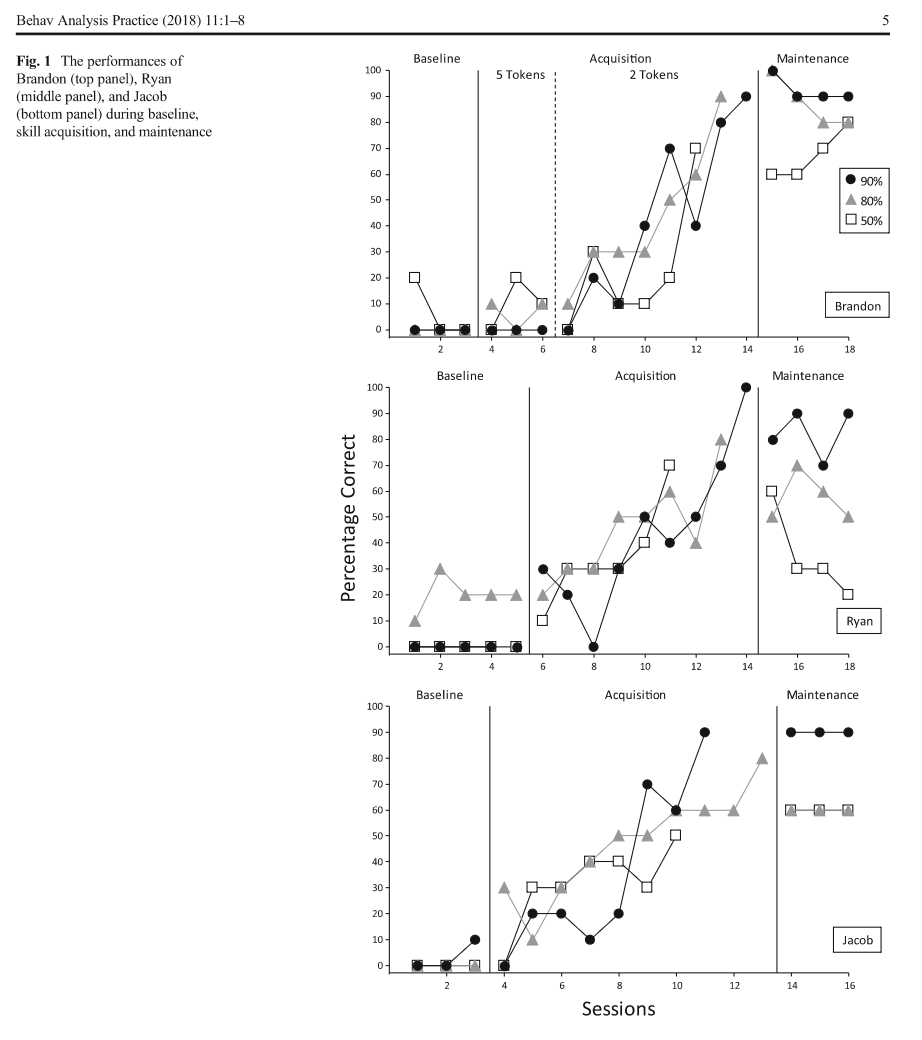
We also discuss findings from their research comparing 50%, 80%, and 90% mastery criteria. Their studies suggest that higher performance criteria may produce stronger maintenance outcomes under some conditions, but they emphasize that practitioners should resist the temptation to adopt a new universal rule.
Along the way, we explore:
- The distinction between mastery criteria and performance criteria.
- Why "80% correct" became so common in ABA.
- Historical influences from early behavior analytic and educational research.
- Research comparing 50%, 80%, and 90% mastery criteria (see below!).
- The relationship between mastery criteria and long-term maintenance.
- Why some behaviors may require near-perfect performance.
- The importance of considering the natural environment when setting performance standards.
- How units of analysis can affect instructional decision making.
- The risks of relying on aggregated data when teaching multiple skills.
- Generalization, maintenance, and supplementary variables.
- Lessons from Precision Teaching regarding fluency and functional mastery.
- Why performance criteria should be individualized rather than universally prescribed.
- Research opportunities for practitioners and graduate students interested in instructional design.
Throughout the discussion, Sarah and Dan make a compelling case for moving beyond inherited rules and toward a more individualized, evidence-based approach to instructional decision making.
Whether you're designing skill acquisition programs, supervising trainees, or simply curious about the assumptions that shape everyday practice, this episode offers a thoughtful examination of one of the most common—and least questioned—features of behavior analytic instruction.
About the Guests
Dr. Sarah Richling
Sarah Richling is a Clinical Associate Professor at Auburn University and serves as Director of Auburn's Master's Program in Applied Behavior Analysis. She has more than two decades of experience as a practitioner, researcher, and educator, with interests spanning instructional design, performance criteria, and effective teaching practices.
Dr. Daniel Fienup
Dan Fienup is a behavior analyst and researcher whose work has focused on instructional variables that affect skill acquisition, maintenance, and educational outcomes. His research on mastery criteria has helped clarify the relationship between performance standards and long-term retention of learned skills.
Resources Mentioned in This Episode
- Fienup and Carr (2021). The use of performance criteria for determining “mastery” in discrete-trial instruction: A call for research.
- Fuller and Fienup (2018). A Preliminary Analysis of Mastery Criterion Level: Effects on Response Maintenance.
- Richling, Fienup, and Wong (2023). Establishing Performance Criteria for Skill Mastery.
- VanDevander, Warner, Kazemi, and Famie (2023). Creating a reference range of common problem behaviors and replacement behaviors in neurotypical children.
- Vladescu, Gureghian, Goodwyn, and Campanaro (2020). Comparing skill acquisition under different stimulus set sizes with children with autism spectrum disorder: A replication.
- Conditioning Books as Reinforcers: How to Increase Reading Engagement in Young Children: Inside JABA 26.
Sponsor Shoutouts!
- Behavior University. Their mission is to provide university quality professional development for the busy Behavior Analyst. Learn about their CEU offerings, including their 8-hour Supervision Course, as well as their RBT offerings over at behavioruniversity.com/observations. Don't forget to use the coupon code, PODCAST to save at checkout!
- Safety-Care is a crisis prevention and de-escalation training program designed for professionals who support individuals with challenging behavior. More than 300,000 professionals have been trained in Safety-Care's evidence-based approach to recognizing early warning signs and responding with confidence. To learn more, visit QBS.com/podcast.
- Learn from your favorite podcast guests while you're commuting, walking the dog, or whatever else you do while listening to podcasts. New events are being added all the time, so check them out here.
- HRIC Recruting. Cut out the middleman and speak directly with Barbara Voss, who's been placing BCBAs in great jobs all across the US for 15 years.
- The BOP Patreon. Do you want to get the show ad-free and before everyone else? Click here to learn how!